August 2, 2027 · total solar eclipse
Six minutes of night at noon.
On Monday, August 2, 2027 the Moon covers the Sun completely along a path from southern Spain and Morocco to Egypt, Saudi Arabia and Somalia. Near Luxor totality lasts 6m 25s, one of the longest total eclipses over land this century. Greatest eclipse is at 10:06 UTC.
The path of totality.
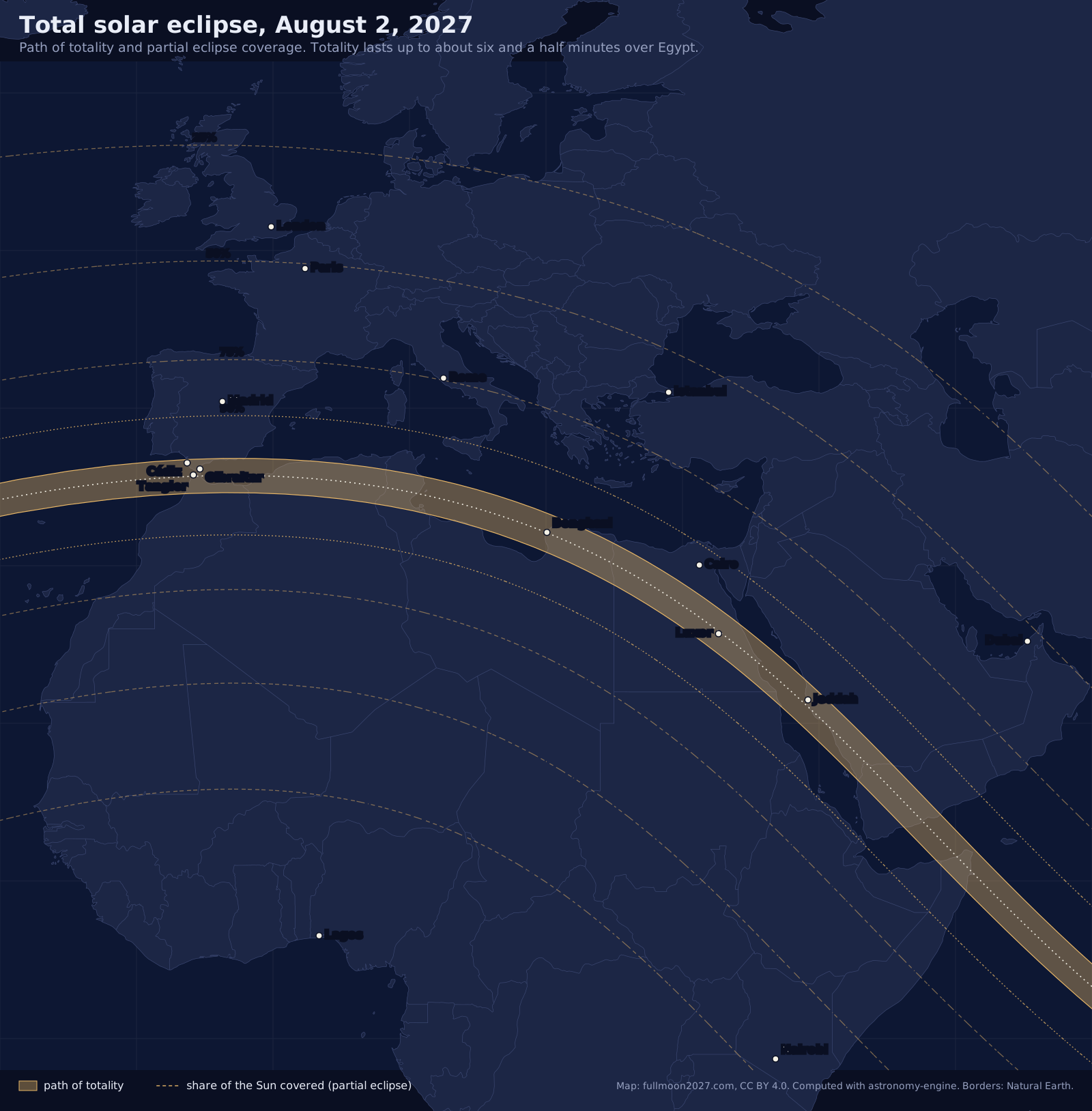
Inside the gold band the Sun is completely covered. The dashed lines show how much of the Sun disappears elsewhere. Computed with astronomy-engine from the positions of the Sun and Moon; the map is free to use with credit (press and licence).
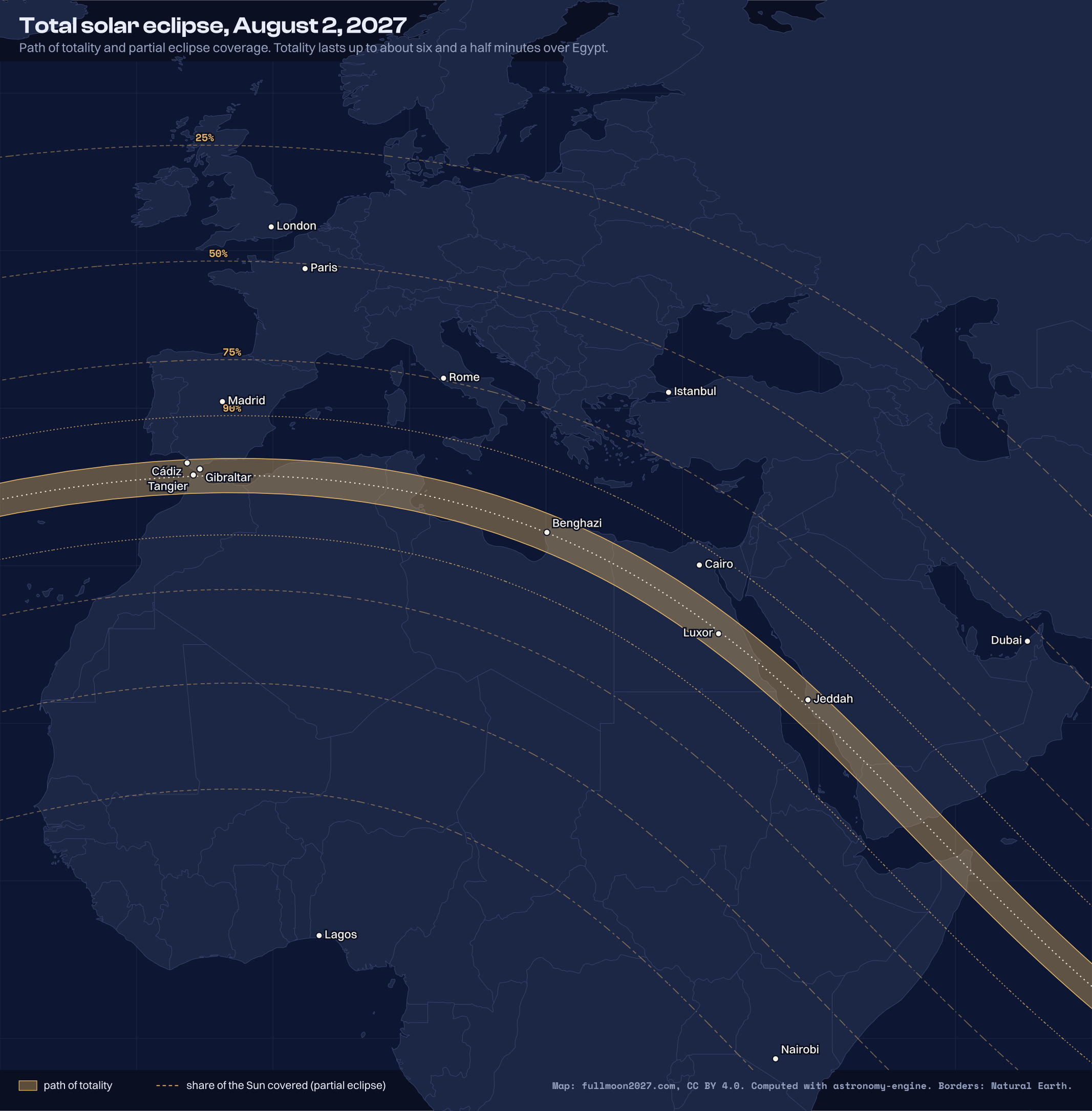
Where to see totality, and for how long.
Local times for totality, computed for each city center. Places marked “near the edge” are within a few kilometers of the limit; there the real duration depends on the exact spot and the Moon’s mountainous edge, so check a limb-corrected map before you book.
| Place | Totality | Total phase starts | Sun altitude | Partial phase |
|---|---|---|---|---|
| Luxor, Egypt | 6m 25s | 13:01 EEST | 82° | 11:40 to 14:26 |
| Benghazi, Libya | 6m 13s | 11:27 EET | 68° | 10:10 to 12:53 |
| Abha, Saudi Arabia | 6m 08s | 13:34 AST | 71° | 12:13 to 14:53 |
| Jeddah, Saudi Arabia | 6m 03s | 13:22 AST | 76° | 12:00 to 14:43 |
| Sfax, Tunisia | 5m 43s | 10:08 CET | 56° | 08:56 to 11:31 |
| Oran, Algeria | 5m 11s | 09:50 CET | 43° | 08:44 to 11:09 |
| Tetouan, Morocco | 4m 55s | 08:45 UTC | 38° | 07:40 to 10:01 |
| Tangier, Morocco | 4m 54s | 08:44 UTC | 38° | 07:40 to 10:00 |
| Ceuta, Spain | 4m 51s | 10:45 CEST | 38° | 09:40 to 12:01 |
| Tarifa, Spain | 4m 41s | 10:44 CEST | 38° | 09:40 to 12:00 |
| Gibraltar | 4m 29s | 10:45 CEST | 38° | 09:41 to 12:00 |
| Bosaso, Somalia | 4m 09s | 13:58 EAT | 58° | 12:39 to 15:11 |
| Cádiz, Spain | 2m 54s | 10:45 CEST | 37° | 09:40 to 11:59 |
| Sanaa, Yemen | 2m 34s | 13:43 AST | 67° | 12:21 to 15:00 |
| Málaga, Spain near the edge | 1m 50s | 10:48 CEST | 39° | 09:42 to 12:02 |
| Jerez de la Frontera, Spain near the edge | 1m 35s | 10:46 CEST | 38° | 09:40 to 11:59 |
| Tripoli, Libya near the edge | 0m 41s | 11:16 EET | 60° | 09:59 to 12:38 |
Europe’s closest totality
Spain, Gibraltar and Morocco.
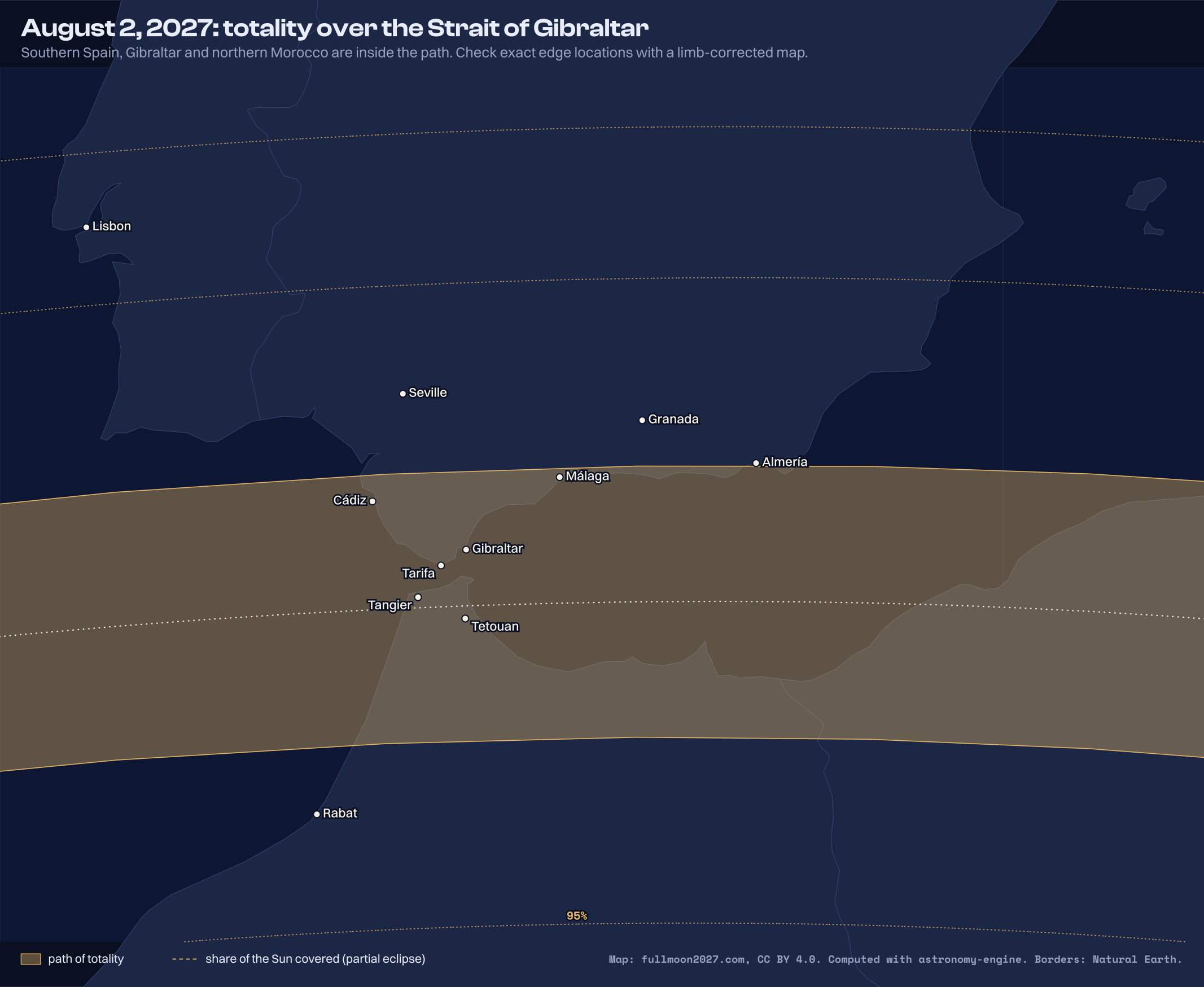
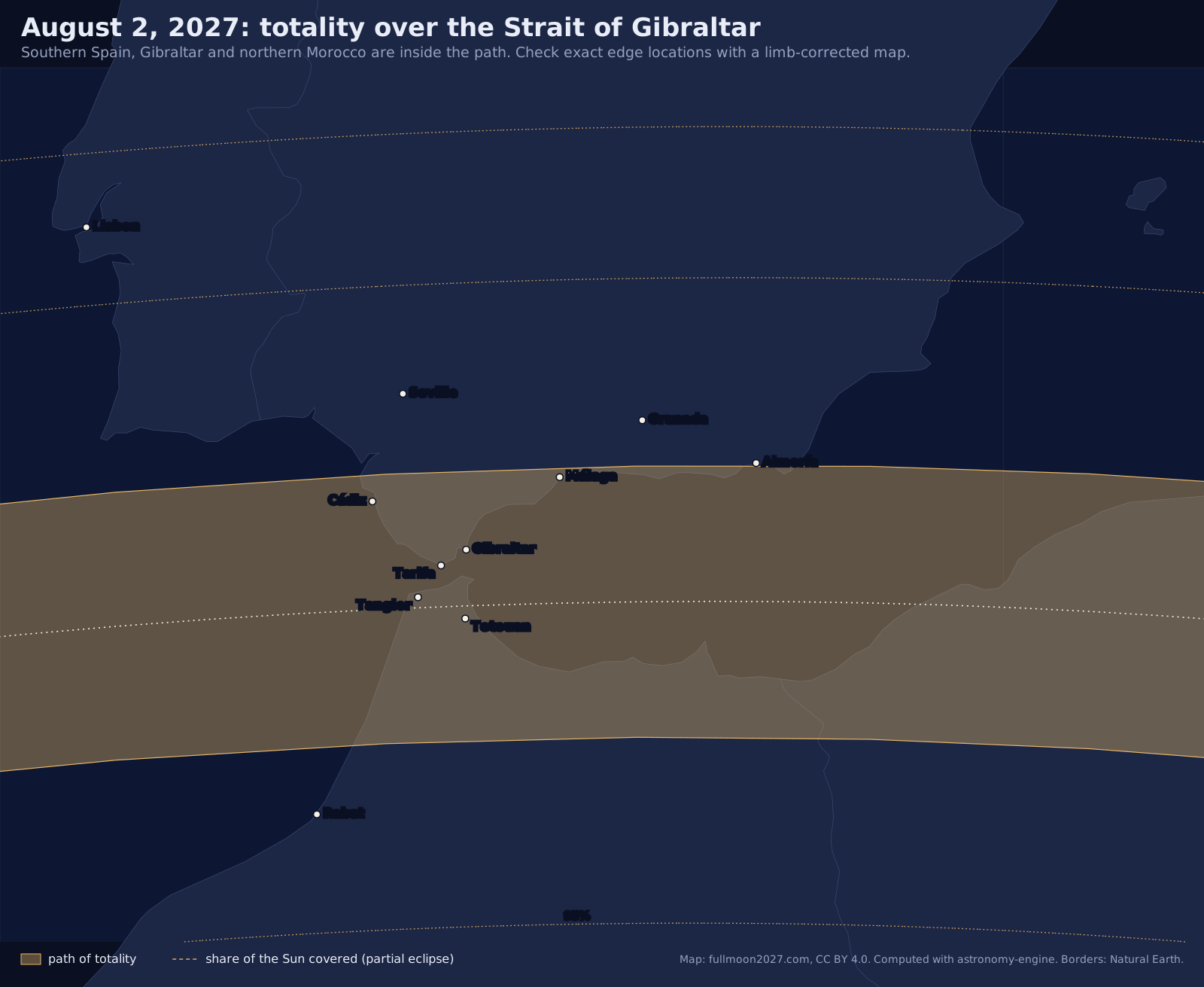
The southern tip of Spain is the only part of mainland Europe inside the path. The center line runs just south of the Strait, so Tarifa, Gibraltar, Ceuta, Tangier and Tetouan get the longest totality in the region, between about four and a half and five minutes, around a quarter to eleven in the morning Spanish time. Cádiz and Málaga are closer to the northern limit and get a shorter total phase. Almería and Granada sit right at the edge on this computation and Seville just outside it: a few kilometers can decide between totality and a 99% partial eclipse, and the two are not comparable.
Weather
Which spot has the best odds of a clear sky?
August is one of the sunniest months along the whole track, but the odds are not equal. The eclipse climatology published by Eclipsophile, the long-running eclipse weather resource, gives Cádiz an 88 percent frequency of sun-visible days in its survey and Gibraltar about a 74 percent chance of a sunny view, while sunshine at Melilla on the Moroccan coast averages only 61 percent of the maximum possible.
Farther east the prospects improve. The same source describes morning cloudiness in Algeria and Tunisia as subdued, rates Benghazi as a very good site, and points to Egypt’s western desert oases, such as Siwa and Bahariya, as places with almost no prospect of cloud. Around Luxor the main concern is thin cirrus. Heat is the other factor: early August in the Egyptian and Saudi deserts is very hot, so plan for shade and water.
Outside the path: the partial eclipse near you.
Coverage is the share of the Sun’s disc hidden at maximum. Even at 99% the sky stays bright and the Sun is dangerous to look at; the famous darkness, the corona and the stars only appear at 100%.
| Place | Coverage | Maximum | Starts | Ends | Sun altitude |
|---|---|---|---|---|---|
| Almería, Spain near the edge | 100% | 10:51 CEST | 09:43 | 12:05 | 41° |
| Algiers, Algeria near the edge | 99.8% | 09:58 CET | 08:48 | 11:15 | 47° |
| Aswan, Egypt near the edge | 99.8% | 13:08 EEST | 11:42 | 14:29 | 83° |
| Tobruk, Libya near the edge | 99.6% | 11:38 EET | 10:17 | 13:00 | 72° |
| Granada, Spain near the edge | 99.2% | 10:50 CEST | 09:42 | 12:03 | 40° |
| Rabat, Morocco | 98.6% | 08:45 UTC | 07:39 | 09:58 | 37° |
| Hurghada, Egypt | 98.5% | 13:04 EEST | 11:40 | 14:25 | 80° |
| Seville, Spain | 98.3% | 10:47 CEST | 09:41 | 11:59 | 38° |
| Tunis, Tunisia | 97% | 10:09 CET | 08:56 | 11:28 | 55° |
| Cairo, Egypt | 94.8% | 12:55 EEST | 11:33 | 14:16 | 78° |
| Medina, Saudi Arabia | 94.4% | 13:20 AST | 11:57 | 14:38 | 76° |
| Alexandria, Egypt | 93.3% | 12:51 EEST | 11:29 | 14:11 | 76° |
| Lisbon, Portugal | 92.4% | 09:44 WEST | 08:40 | 10:54 | 35° |
| Madrid, Spain | 86.2% | 10:51 CEST | 09:45 | 12:02 | 40° |
| Tel Aviv, Israel | 80.3% | 12:59 IDT | 11:39 | 14:16 | 75° |
| Athens, Greece | 78.2% | 12:32 EEST | 11:16 | 13:49 | 66° |
| Riyadh, Saudi Arabia | 75.8% | 13:32 AST | 12:13 | 14:44 | 67° |
| Rome, Italy | 74.4% | 11:12 CEST | 10:02 | 12:26 | 54° |
| Addis Ababa, Ethiopia | 66.6% | 13:47 EAT | 12:24 | 15:01 | 70° |
| Istanbul, Turkey | 59.3% | 12:39 TRT | 11:27 | 13:50 | 66° |
| Dubai, UAE | 53.2% | 14:43 GST | 13:33 | 15:47 | 57° |
| Paris, France | 51.2% | 11:01 CEST | 10:00 | 12:04 | 43° |
| London | 41.8% | 10:00 BST | 09:03 | 10:59 | 40° |
| Amsterdam, Netherlands | 37.8% | 11:05 CEST | 10:08 | 12:03 | 43° |
| Dublin, Ireland | 35.6% | 09:56 UTC+1 | 09:03 | 10:51 | 36° |
| Berlin, Germany | 33.9% | 11:13 CEST | 10:17 | 12:11 | 48° |
| Nairobi, Kenya | 30.8% | 14:01 EAT | 12:52 | 15:04 | 62° |
| Edinburgh, UK | 27.2% | 10:00 BST | 09:11 | 10:51 | 37° |
| New Delhi | 8.2% | 16:29 IST | 15:53 | 17:02 | 34° |
| Lagos | 2.4% | 10:13 WAT | 09:41 | 10:46 | 50° |
Why it is special
Why 99% is not the same as totality.
A total solar eclipse is not a darker version of a partial one. As long as even a thin crescent of the Sun is visible, it is bright enough to hurt your eyes and to keep the sky blue. In the last seconds the crescent breaks into beads of light, the temperature drops, and then the Sun’s corona appears around a black disc while planets and bright stars come out in the middle of the day. That only happens inside the path.
Totality on August 2, 2027 is so long because three things line up: the Moon is close to perigee, so its disc looks large; Earth is near aphelion, so the Sun looks slightly small; and over Egypt the Sun is nearly overhead, so observers there are closest to the Moon’s shadow. The new moon behind the eclipse has its own page, with meaning and local times: new moon August 2, 2027.
- Before: certified glasses (ISO 12312-2) or a pinhole projector for the partial phase, which lasts over an hour.
- Totality: glasses off only when the Sun is fully covered, and back on at the first flash of sunlight.
- Cameras and binoculars: never point them at the partial Sun without a proper solar filter on the front.
Press and educators
Use the maps and tables.
The eclipse maps, local circumstances and moon data are free to publish under CC BY 4.0 with credit to fullmoon2027.com.
FAQ
The 2027 eclipse, answered.
Where is the August 2, 2027 total solar eclipse visible?
The path of totality crosses the Atlantic, the Strait of Gibraltar with southern Spain, Gibraltar, Ceuta and northern Morocco, then Algeria, Tunisia, Libya and Egypt, the Red Sea, Saudi Arabia, Yemen and Somalia. A partial eclipse is visible across Europe, North and East Africa, the Middle East and western Asia.
How long does totality last on August 2, 2027?
Up to about six and a half minutes in Egypt near Luxor. Computed for places on this page: Luxor 6m 25s, Benghazi 6m 13s, Abha 6m 08s, Jeddah 6m 03s, Sfax 5m 43s. In southern Spain and northern Morocco totality lasts from about one and a half to five minutes, depending on how close you are to the center line.
What time is the eclipse in Spain?
In southern Spain totality happens in the late morning, around 10:45 CEST. Cádiz gets about 2m 54s, Tarifa about 4m 41s and Málaga about 1m 50s. Madrid and Seville see a deep partial eclipse only.
Can you see the 2027 eclipse from the UK?
Only as a partial eclipse. In London about 42% of the Sun is covered at 10:00 BST. Eye protection is needed the whole time.
Is it safe to look at a total solar eclipse?
Only during totality, inside the path, and only while the Sun is completely covered. Before and after, including the last seconds of the partial phase, use certified solar eclipse glasses that meet the ISO 12312-2 standard, or project the Sun through a pinhole. Outside the path of totality there is no safe moment without protection.
Also in 2027: an annular solar eclipse on February 6 and three penumbral lunar eclipses. See all eclipses of 2027. Computed center of the longest totality: 26.54° N, 31.56° E.